GolfLaunchLab's verdict: the Golf Daddy is not a launch monitor and not a true simulator. It is a pressure-sensing mat (around $120 on sale, $299 list) paired with an AI smartphone-camera app. You swing a real club over the mat, the phone camera watches the swing, and the app estimates what the ball flight might have been: no radar, no photometric cameras, no ball tracking of any kind. The concept has appeal for absolute beginners and casual indoor practice. The execution, however, draws mixed reviews: user feedback flags inconsistent shot detection, setup friction, and distance estimates that can swing widely from what a real launch monitor would show. If you want real data to improve your game, budget an extra $100 for the Shot Scope LM1 ($199) and get actual Doppler radar tracking of a real ball. The Golf Daddy is cheap entertainment, not a performance tool.
- Cheapest entry point to indoor "simulator" experience (around $120 on sale)
- No ball needed: swing practice anywhere
- 35+ virtual courses in the app
- Compact and portable: fits in a backpack
- Available at Dick's, Golf Galaxy, and Amazon
- No ball tracking, all data is estimated from swing motion
- Does not use radar, photometrics, or infrared
- Mixed user reviews on accuracy and shot registration
- Premium coaching requires additional in-app purchase
- Cannot replace a real launch monitor for meaningful data
Specs & What's in the Box
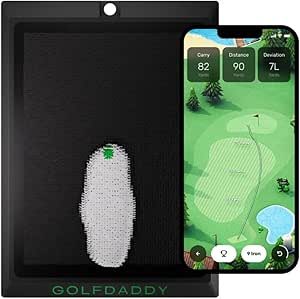
The Golf Daddy (also marketed as Golf At Home) is a budget swing-training system, not a launch monitor. It pairs a pressure-sensing mat with an AI smartphone-camera app to estimate ball flight from your swing mechanics. Nothing in the system measures an actual ball after impact.
You set up the included phone tripod, mount your smartphone, position it above the mat, and swing a real club. The app watches the swing via camera and estimates swing speed, distance, and shot direction. Those estimated metrics are then rendered on one of 35+ virtual courses in the app.
This is an important distinction: a training aid and entertainment device, not a launch monitor. It does not measure ball speed, spin rate, launch angle, smash factor, or clubface angle, because it never sees a ball. Every number it displays is inferred from your swing motion alone.
How the Golf Daddy Simulator Works
The Golf Daddy system has three components working together: a pressure-sensing mat, your phone camera on a tripod, and an AI-powered mobile app.
Step 1: Set up the mat and tripod. Place the hitting mat on a flat surface indoors or outdoors. Mount your phone on the included tripod so the camera has a clear view of the mat and swing zone. The app guides you through positioning.
Step 2: Calibrate. The app needs to map the mat position, your stance, and the camera angle before it will register swings. Multiple user reviews flag this step as time-consuming and sensitive to lighting and camera distance. Conditions that worked one session may require full recalibration the next.
Step 3: Swing. Once calibrated, you swing a real club over the mat (with or without the rubber tee). The phone camera captures the swing motion and the AI analyzes club path, speed, and mat contact. No golf ball is involved at any point.
Step 4: AI generates estimated ball flight. Based on what the camera sees, the app estimates what ball flight would have occurred and renders it on a virtual course. You get estimated swing speed, estimated distance, and estimated shot direction.
App & Software Experience
The Golf Daddy app is central to the experience. The base app includes 35+ virtual courses and a practice range mode. Course visuals are colorful and functional for a mobile experience at this price point. Premium coaching content is available as a separate in-app purchase: the base package does not include it.
Game modes include full rounds, driving range practice, and closest-to-the-pin challenges. For casual indoor entertainment, the variety is reasonable at this price.
Setup friction. User reviews consistently flag calibration as the weakest part of the experience. The app needs specific lighting, a consistent camera angle, and a fixed distance from the mat. Changing rooms, lighting conditions, or phone position often means starting calibration over. Multiple reviews describe sessions where calibration alone consumed significant time.
Shot registration. A recurring complaint in user reviews is missed swings: full swings that the app fails to register, requiring a re-swing. This breaks the rhythm of a practice session and slows virtual rounds considerably.
App updates. Golf Daddy pushes regular software updates, and some user complaints visible in older reviews may have been partially addressed. Check recent reviews on Amazon or the app store for the current state of the software experience.
Accuracy Reality Check
Let's be direct about what "accuracy" means for the Golf Daddy: it does not track a real golf ball, so comparing its estimates to real launch monitor data is not a meaningful test. The numbers it displays are AI estimates derived from swing motion captured by a phone camera, not measurements of a ball in flight.
| What Golf Daddy Estimates | How It Gets the Number | Reliability |
|---|---|---|
| Swing speed | Estimated from phone camera footage of club motion | Rough estimate |
| Distance | AI-estimated from swing data; no ball tracked | Mixed user reports |
| Shot direction | Inferred from swing path over mat | Directional only |
| Consistency | Same swing can produce different outputs | Flagged in reviews |
| Shot registration | Camera-dependent; misses reported | Inconsistent |
The fundamental limitation is architectural, not fixable with software alone. Two golfers with identical swing speeds can produce very different ball flights depending on clubface angle, strike location on the face, spin, and compression. Without measuring the actual ball, the system is always estimating, and those estimates will diverge from real data by varying amounts depending on your swing.
User reviews on Amazon are mixed on how far off the estimates run. Some users find the experience fun and "close enough" for casual entertainment. Others report distance readings that feel meaningfully disconnected from what they know their real carry to be. The honest answer is: the Golf Daddy is not designed to give you accurate launch data, and you should not buy it for that purpose.
Our Detailed Scores
Alternatives to Consider
If you are considering the Golf Daddy because of the price, here is what else is available at nearby price points. These are real launch monitors that track actual golf balls: a fundamentally different and more useful category:
| Product | Price | Score | Why Consider It Instead |
|---|---|---|---|
| Shot Scope LM1 | $199 | 8.0 | Real Doppler radar, built-in display, no phone needed. Only about $80 more. |
| PRGR HS-130A | $230 | 7.6 | Doppler radar ball and club speed. Simple, proven, no app required. |
| Square Golf Omni | $249 | 8.2 | Real ball tracking, app with shot history, no subscription required. |
| Garmin Approach R10 | $500 | 9.1 | 14 tracked metrics, full simulator ecosystem, Garmin reliability. |
FAQ
Get Alerted When the Gear You Want Drops in Price
Hand-verified price checks on 20+ launch monitors and rangefinders. We only email when something meaningfully drops or a major sale hits. No daily deal spam. Free bonus: the golf distance cheat sheet, instantly.